It's already and finally the last day of school.
As I type this - both my classrooms are packed up for the summer. Posters are down, boxes are stacked, bookshelves are covered, and that pile of crap that I have meant to 'put away' since sometime in October has finally been taken care of.
::sigh::
My rooms feel so empty, so foreign -- it's like cleaning out your dorm room and realizing that it was never really yours to begin with.
There are so many things we did this year - so many great memories. At the same time I feel like there is so much that I didn't accomplish, so many projects and ideas that are still on the 'inspiration/to do lists'. (Never fear, most of them are pinned ;))
Good bye classrooms. I shall see you soon - I shall be excited, ready, and my patience restored!
Organized Chaos
Creating and teaching art requires a sense of humor and an understanding of organized chaos - as there is no way to create something original without spreading out supplies and getting a little messy.
6.14.2013
5.13.2013
ArtShow2013
ArtShow2013 was a huge success!
I don't even know where to start.
I like to have students pick their best work from the year to display at art show - but I don't have the room to keep portfolios for 500 or so kids and I don't like keep artwork instead of sending it home. So, what I do is this: When we have completed two projects I have the kids pick which one they did better on and send the other home. We do this all year so that we always have something picked out for art show, but artwork also goes home. Often times students pick artwork that I don't feel is their best work - and if I ask them why they pick it, their choice is clear. Students that pick a project that has an end product that is less than their best often pick those because of the process - which is just as important.
I love doing it this way because it creates a great variety of work for ArtShow - giving both parents and I a year review of what has been happening in the art room. When we get about a month out from art show we start finalizing projects, signing labels, double and triple checking class lists. It takes about a month to gather all the projects because kids are sick, at Dr. appointments, on vacation, and any other reason for missing art.
Once projects are finalized I added signed labels and QR codes to each and every project.
Yes QR codes on each project. Why? Other than because I'm crazy - I am always trying to advocate for my program, reaching out to parents in anyway possible. Each QR code leads parents to this blog, and specifically to the blog post about that particular project. I could have made it easier and put the same generic QR code on each project, but that seemed pointless. My goal was, and is, to communicate to parents about the lessons behind the projects - so to make it easy on them each QR code was specialized.
QR codes are EASY to make. Goggle "QR code generator" and you'll get LOTS of hits and websites to make the codes for free. Put in your desired URL (or other info), generate the QR code, download - simple!Now, I tried to make this as easy as possible on myself and opened Microsoft Word, downloaded a return address label template, imported the QR code - copy and pasted putting two QR codes on each label. I did this for either a full sheet or half a sheet depending on how many I thought I would need.
Then I sat on the floor in my house, cut and stuck QR codes to each corresponding project. My cat Phineas was so helpful in this process!The day arrived to set up ArtShow2013. This year I got to be in the Cafetorium, because 2nd grade production was done earlier in the year. I LOVED being in the Cafetorium. I had WAY more room. I spent the day putting up grids, clipping artwork, setting out clay pieces on their own labels.
It looked AWESOME.
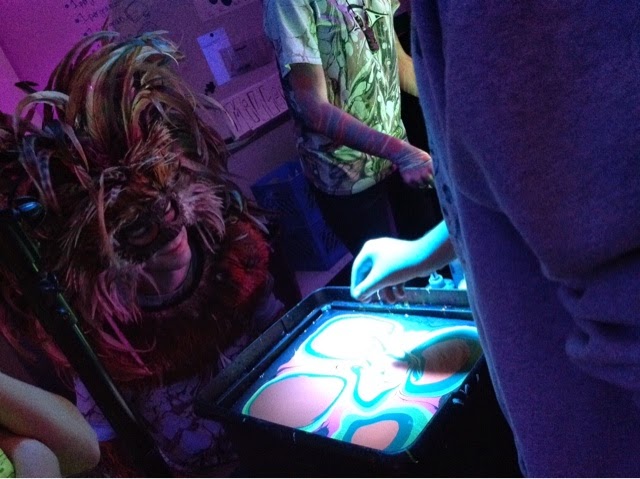
After everything was set out I then needed to set up my light graffiti booth and my stop motion animation area. I asked two teachers with teenage daughters if they would be willing to volunteer sometime to art show. They both agreed and I was thrilled! I had one daughter on the stage, in the dark with an iPad, flashlights, ghost light, and an iPad app called, "Slow Shutter". Here families could make light graffiti together. When I told students there was light graffiti on the stage - their eyes got wide and immediately they were dragging their families to the stage. I used this app instead of a camera because it allowed families to e-mail themselves the photo right after it was made. This way I didn't have to try and figure out which went with what family.I also had a table in the corner set up with Stop Motion animation. Students were introduced to it the week of ArtShow and were eager to share with their parents how it worked. Families worked together through out the night to create the video below.
5.06.2013
Kindergarten People
Every year with kinders I use drawing people as my way to see how the kids are progressing.
The 2nd or 3rd project in the year I have students draw the best people they can without any pre-teaching. I use this to see if they are at a scribble stage, cookie people stage..... etc. The next class I ask the students to color in their people - I look to see who selects colors, who colors in, who colors over, who sticks with one color crayon.... etc.
Then midway through the year we draw people again. This time I ask them to draw people with their heads at the top of their paper and toes at the bottom. We do an example drawing where students help me fill in eyes, nose, hair, ears, mouth, fingers.... on and on. The students do another drawing and color the next class. I specifically ask students to pick colors on purpose and to color IN their picture instead of over. At this point most students have graduated past cookie people and have full bodies -- and most will color IN their picture, but many still pick random colors.
At the end of the year we read "Giraffes Can't Dance" and talk about how they know the animals in the pictures are dancing since the pictures don't move. It is really interesting to listen to kids try and explain what they see. After the book we have our own freeze dance party!!! I play different types of music and the kids dance around - when the music pauses so do the kids. I have them look around at how they are standing -- bent arms, bent legs, tilted heads....
Then I have the students draw people again - I ask them to draw at least one arm and one leg to be bent. Next class, just like before, students color IN with colors that make sense.
At this point in the year I am looking for better motor control, the ability to use their favorite color on shirts/pants/shoes instead of faces and hair.
The 2nd or 3rd project in the year I have students draw the best people they can without any pre-teaching. I use this to see if they are at a scribble stage, cookie people stage..... etc. The next class I ask the students to color in their people - I look to see who selects colors, who colors in, who colors over, who sticks with one color crayon.... etc.
Then midway through the year we draw people again. This time I ask them to draw people with their heads at the top of their paper and toes at the bottom. We do an example drawing where students help me fill in eyes, nose, hair, ears, mouth, fingers.... on and on. The students do another drawing and color the next class. I specifically ask students to pick colors on purpose and to color IN their picture instead of over. At this point most students have graduated past cookie people and have full bodies -- and most will color IN their picture, but many still pick random colors.At the end of the year we read "Giraffes Can't Dance" and talk about how they know the animals in the pictures are dancing since the pictures don't move. It is really interesting to listen to kids try and explain what they see. After the book we have our own freeze dance party!!! I play different types of music and the kids dance around - when the music pauses so do the kids. I have them look around at how they are standing -- bent arms, bent legs, tilted heads....
Then I have the students draw people again - I ask them to draw at least one arm and one leg to be bent. Next class, just like before, students color IN with colors that make sense.
At this point in the year I am looking for better motor control, the ability to use their favorite color on shirts/pants/shoes instead of faces and hair.
1-5th Grades -- Stop Motion Animation (Week 1)
I have always wanted to do a stop motion animation project with students but was overwhelmed the the amount of equipment I would need -- cameras, tripods, computers, computer software, a computer lab.... times however many groups I would have.Then came iPads and iPad apps. Sometime during the summer or fall I found an app called 'Stop Motion'. It's a .99 cent app that is super user friendly that creates stop motion animation -- you can do all sorts of things directly in this app to have a full video of awesomeness.
Now that I found the app I just needed enough iPads - which was almost as overwhelming as needing ALL the extra equipment. Lucky for me our building purchased a few iPads for teacher/student use. I claimed the iPads for two weeks in May to try out stop motion animation!

I waited. I planned.
May came and suddenly it was time to load up the iPads with Stop Motion and pray to the art teaching gods that my lesson plan would work.
The week before I drew out some backgrounds on some old file folders and asked students to color them when they were finished with work.
I also took some GIANT white paper, an iPad, and a ruler to grid out the sight lines of the camera. I had students color this grey.
The day came to put all my planning to the test - about 20 minutes before my first class walked in I tried to download the .99 app only to find no way to purchase the app and download it on each iPad. (rightfully so, the school ipads did not come with a credit card on file). I started to panic. Would I really need to buy 10.00 gift cards for each one for a 99 cent app?!!? Then I got smart. I gifted Stop Motion to myself 4 times and redeemed them on each ipad. WHEW. That was close.
How I set it up:
3-5 kids in a group depending on how many students are in class (I had 6 stations)
1 Large white paper with grey trapizoid
1 background
1 iPad loaded with Stop Motion
Pattern blocks
1 ruler to angle iPad
I explained how the app worked, their job, how to rotate through being the director, and stressed as much as I could to NOT MOVE THE IPAD OR THE BACKGROUND.

One student is the Director at a time. The director's job is to make sure all body parts are out of the shot- take the picture - then tell group to move pieces. I set a timer for 2 or 3 minutes (depending on group size). When the timer goes off directors change. The director doesn't get to boss around what the movers do - their only job is to clear the picture of body parts and take the picture. The group works together to make ONE long video - the video DOES NOT change when the director does.
The lesson worked even better than I expected. The kids used the app with little help or instruction. I did find that the older students did a better job being patient and moving pieces a little at a time - the younger kids seemed to get excited and make larger movements between pictures.
Towards the end of class I have groups clean up their stations while I collect their iPads and turn on the projector. When everyone is cleaned up we watch their movies on the digital projector. (All you need is an adapter that goes from your iPad to VGA cable for the projector).
Overall the lesson was a complete success - I have parents e-mailing asking what app it is, students are begging to do it again next time (which I already have planned!)
2nd Grade -- Jasper John meets Dr. Martin Luther King Jr.
Back, way back in the year right around Dr. Martin Luther King Jr. day I had 2nd graders combine the positive ideas of Dr. King with the amazing paintings of the Jasper Johns.
We started of by watching part of Dr. King's "I Have a Dream" speech.
Next, we brainstormed words that were positive.
Students then picked a word and wrote it in thick bubble letters on a piece of paper. The thicker the bubble letters the better, if the letters are too skinny it will be hard to read.
The next class we looked at paintings by Jasper John and I asked them, "How can we see his numbers even though his paintings are messy and he doesn't outline?" It took kids a while to figure out how to explain what they were seeing. Once students voiced the idea that he used different colors on the edges - so the inside edge might be yellow but the outside is blue.

I passed out primary colors with white and showed students how to freely paint by double or triple dipping their paint brush. I tried to stress that they needed to make the background different than their letter so we could read them.
Honestly, this lesson didn't turn out exactly how I had planned - but students LOVED it. They really got into making different colors and painting making it hard to read many of their words. Even though the end product wasn't exactly what I had envisioned, the project taught more than I expected.
We started of by watching part of Dr. King's "I Have a Dream" speech.
Next, we brainstormed words that were positive.
Students then picked a word and wrote it in thick bubble letters on a piece of paper. The thicker the bubble letters the better, if the letters are too skinny it will be hard to read.
The next class we looked at paintings by Jasper John and I asked them, "How can we see his numbers even though his paintings are messy and he doesn't outline?" It took kids a while to figure out how to explain what they were seeing. Once students voiced the idea that he used different colors on the edges - so the inside edge might be yellow but the outside is blue.
![]() |
| Jasper Johns |

I passed out primary colors with white and showed students how to freely paint by double or triple dipping their paint brush. I tried to stress that they needed to make the background different than their letter so we could read them.Honestly, this lesson didn't turn out exactly how I had planned - but students LOVED it. They really got into making different colors and painting making it hard to read many of their words. Even though the end product wasn't exactly what I had envisioned, the project taught more than I expected.
5.02.2013
3rd and 4th Grade -- CD weavings
Last year at the end of the year our building Tech came to me with a box of CD's asking if I could use them.
SURE! I said.
Fast forward to this year and suddenly CD weavings are popping up everywhere - Pinterest, other art teachers in my district, blogs. I decided to jump on the band wagon and give it a try!
I started kids out with a CD, or rather their LOOM. Next, I gave them a piece of warp thread - it was my wingspan, about 5 ft. Students put the warp thread through the middle of the loom and tied a TIGHT square knot on the back. Next, students wrapped the remaining thread through the middle, then around the outside edge, until they ran out of thread. Then, students counted how many strings they had on the front - they needed to have an ODD number (most had 11 or 13, a few 9).
IMPORTANT: The tighter the warp thread is on the loom the easier it will be to weave.
Next class I showed students how to measure a piece of yarn using their arms as a measuring stick - finger tips to shoulder, then how to thread the yarn on a tapestry needle. (HINT: my mom taught me this-- don't use the end of the string, instead make a little loop, pinch the top of the loop to make a bump, put the eye of the needle on the bump, wiggle the bump a little and it will slide right into the eye!). Do not tie on the needle. Students learn quickly to pull the thread not the needle when pulling weft thread tight.
Students then pick a spot on their warp thread, put the needle under, over, under, PULL - pull till the end of the string almost goes under that first warp thread. Hold down the end of the weft thread while you continue with the needle all the way around - over, under, over, under.... when you get back to the beginning the weft string will overlap the end and hold it in place. Weave till you run out of string. When the string runs out - end it on an 'under' movement. Measure new string, start where the last string ended and keep going! (video to come)
The first couple of strings were the most thought provoking for the students - but after that they CRUISED! In fact students would beg to take them home to work on them and would exclaim with excitement when they would return to finish them!
To be done students could either weave to the very edge or stop about an inch short and color with Sharpies.
I will totally do these again!
***NOTES***
- Make warp thread TIGHT.
- Make sure there are an odd number of warp threads.
- Make students thread their own needles.
- Don't let students tie on their needles (unless absolutely needed)
SURE! I said.Fast forward to this year and suddenly CD weavings are popping up everywhere - Pinterest, other art teachers in my district, blogs. I decided to jump on the band wagon and give it a try!
I started kids out with a CD, or rather their LOOM. Next, I gave them a piece of warp thread - it was my wingspan, about 5 ft. Students put the warp thread through the middle of the loom and tied a TIGHT square knot on the back. Next, students wrapped the remaining thread through the middle, then around the outside edge, until they ran out of thread. Then, students counted how many strings they had on the front - they needed to have an ODD number (most had 11 or 13, a few 9).
IMPORTANT: The tighter the warp thread is on the loom the easier it will be to weave.
Next class I showed students how to measure a piece of yarn using their arms as a measuring stick - finger tips to shoulder, then how to thread the yarn on a tapestry needle. (HINT: my mom taught me this-- don't use the end of the string, instead make a little loop, pinch the top of the loop to make a bump, put the eye of the needle on the bump, wiggle the bump a little and it will slide right into the eye!). Do not tie on the needle. Students learn quickly to pull the thread not the needle when pulling weft thread tight. Students then pick a spot on their warp thread, put the needle under, over, under, PULL - pull till the end of the string almost goes under that first warp thread. Hold down the end of the weft thread while you continue with the needle all the way around - over, under, over, under.... when you get back to the beginning the weft string will overlap the end and hold it in place. Weave till you run out of string. When the string runs out - end it on an 'under' movement. Measure new string, start where the last string ended and keep going! (video to come)
The first couple of strings were the most thought provoking for the students - but after that they CRUISED! In fact students would beg to take them home to work on them and would exclaim with excitement when they would return to finish them!To be done students could either weave to the very edge or stop about an inch short and color with Sharpies.
I will totally do these again!
***NOTES***
- Make warp thread TIGHT.
- Make sure there are an odd number of warp threads.
- Make students thread their own needles.
- Don't let students tie on their needles (unless absolutely needed)
4th Grade - I Am Poems
I originally saw this project either on Pinterest or a blog.... I can't remember anymore. The original post was with a 1st grade class where the kids painted the background, a candid picture was taken, and a sentence was added. I LOVED the personality of these and decided to make it a little harder. In my old district the 3rd graders created these fantastic poems based off the book "I am America" that I decided would be PERFECT for my project.
So, the first day I had students watercolor their paper using liquid watercolors and salt. I asked that they do abstract paintings - using only lines and shapes, no smiley faces, no Michigan S, no suns, no hearts (I realize hearts are a shape), and so on. The students were so intrigued by what the salt did to their paintings that they didn't even think about adding cute-sy images.
Day two I had the kids write down 15 things about themselves on a piece of paper - I gave them 10 minutes to do this. I asked them to write a word or two for each thing, no sentences. (Have you ever watched a 4th grader compose a sentence?!? oh boy.)
Next I read them "I am America".
After we talked about patterns in the book - how it was worded. Does it make sense to say, "I am blue jeans?" -- What does that mean? Does it actually mean the person is made of blue jeans?! We discuss and when I felt like the kids got it I introduced the next part.
On the back of their paper students write 10 sentences combining their ideas about themselves and the wording from "I am America". So, for example if I wrote, "green" on the front, on the back I might right, "I am bright green fresh cut grass." Or if I wrote, "cheese pizza" on the front, on the back I might right, "I am gooey hot cheese pizza".
My goal was to get students to stretch their sentences to be more than "I like pizza". Most students enjoyed coming up with words like, dazzling shimmering, bold, loud, awesome... etc.
The next time I saw students I booked the computer lab and I had students type their 10 sentences. I figured this would take 15-20 minutes.. BOY WAS I WRONG!! Have you ever watched 4th graders type?!?!?! WoW. It took them a full 50 minutes and even then some were finishing up.
I had students type all 10 sentences first, THEN if they had time students were allowed to go back and change fonts, colors, and sizes of their text. We printed them out and kept them till next class.
The very last day of this project I printed out pictures I took of them, handed them their poem and asked them to cut neatly! Then they arranged their poem AND their picture to make a unique composition. Last but not least - it all got glued down.
These are breathtaking to look at. The contrast between the bright background and their black and white pictures are perfect.
This project took many classes to do, but the end product was well worth it.
**NOTE** To protect images of my students the pictures presented are cropped and do not show full project.
So, the first day I had students watercolor their paper using liquid watercolors and salt. I asked that they do abstract paintings - using only lines and shapes, no smiley faces, no Michigan S, no suns, no hearts (I realize hearts are a shape), and so on. The students were so intrigued by what the salt did to their paintings that they didn't even think about adding cute-sy images.
Day two I had the kids write down 15 things about themselves on a piece of paper - I gave them 10 minutes to do this. I asked them to write a word or two for each thing, no sentences. (Have you ever watched a 4th grader compose a sentence?!? oh boy.)
Next I read them "I am America".
After we talked about patterns in the book - how it was worded. Does it make sense to say, "I am blue jeans?" -- What does that mean? Does it actually mean the person is made of blue jeans?! We discuss and when I felt like the kids got it I introduced the next part.
On the back of their paper students write 10 sentences combining their ideas about themselves and the wording from "I am America". So, for example if I wrote, "green" on the front, on the back I might right, "I am bright green fresh cut grass." Or if I wrote, "cheese pizza" on the front, on the back I might right, "I am gooey hot cheese pizza".
My goal was to get students to stretch their sentences to be more than "I like pizza". Most students enjoyed coming up with words like, dazzling shimmering, bold, loud, awesome... etc.
The next time I saw students I booked the computer lab and I had students type their 10 sentences. I figured this would take 15-20 minutes.. BOY WAS I WRONG!! Have you ever watched 4th graders type?!?!?! WoW. It took them a full 50 minutes and even then some were finishing up.
I had students type all 10 sentences first, THEN if they had time students were allowed to go back and change fonts, colors, and sizes of their text. We printed them out and kept them till next class.
The very last day of this project I printed out pictures I took of them, handed them their poem and asked them to cut neatly! Then they arranged their poem AND their picture to make a unique composition. Last but not least - it all got glued down.
These are breathtaking to look at. The contrast between the bright background and their black and white pictures are perfect.
This project took many classes to do, but the end product was well worth it.
**NOTE** To protect images of my students the pictures presented are cropped and do not show full project.
Labels:
4 Grade
5.01.2013
Principal Fires Security Detail to Higher Arts Teachers
If I could embed this video/story I TOTALLY would. If you have been following Organized Chaos over the years, I am pretty passionate about the important of the Arts - that the Arts are a fundamental part of humanity. I feel as though I am always trying to convince and prove that what I do is more than cutting and gluing. Here is another real world story where the ARTS are saving students, where people are finding themselves and their futures in ARTS education.
CHECK OUT THE AWESOMENESS!
Principal Fires Security to Higher Arts Teachers
CHECK OUT THE AWESOMENESS!
Principal Fires Security to Higher Arts Teachers
Paper Weavings (k,1,3,4)
Weaving was one of the classes in college that made me realize that I wanted to be an art teacher.
Weird, right?
Weaving was the first class where everything made sense. It was the first class I had ever had that I didn't struggle to understand processes, concepts, or anything else. In my entire school career it was the first class I had where I felt smart. I have some learning disabilities that make retaining oral information difficult for me - so most classes are tough and lectures were a nightmare. Weaving was the first class where everything was explained with examples and showing/doing it -- it totally made sense to me. It was in my weaving class where I realized that other kids who learn just like me are actually smart and they need a space to feel smart - where it doesn't matter if letters move, or you can't read fast, or if numbers just don't make sense. Art is for everyone, but especially for those kids who aren't 'smart' based on their state test scores.
I could go on -- but back to our weavings.
So, for as much as I LOVE weaving - I have never woven with students. The idea seemed overwhelming to me. I struggled with how to organize the materials and be available to help students as they had questions and needed assessment.
At last I decided to jump in and see how it went.
It went WAY BETTER than I expected.
Kids are born weavers.
Kids that I expected to struggle with weaving because the struggled with other art skills -- SOARED and kids that I expected to breeze through it struggled a bit. Why? I am not completely sure. I think it has something to do with the combination of fine motor skills, ability to recognize patterns, willingness to correct mistakes, and other crazy brain functions I can only pretend to know about.
For the Kinders and 1st grade kids I made very simple looms. I provided students with their "warp thread" precut and attached at the top. I gave them strips of paper they needed to weave over, under, over, under until they filled their paper. We then either glued down the flaps or I taped the flaps on the back. Students LOVED seeing their weavings get longer - many even made patterns with the paper they picked.
For the 3rd graders - I had them make their warp threads. We spent a class with rules and pencils to make sure their warp threads were even and in the right spaces. A few students had to redo theirs when they quit and did it halfway trying to take the easy way out -- instead they had to do twice as much work. Once their loom was done I left them pick which design they wanted from some patterns. I showed them how to read the pattern one line at a time, then weave it -- next line and so on. Many students caught on after a couple of lines, a few students needed some extra help. They did GREAT!
4th graders made their own looms as well, but instead of weaving a pre-made pattern, I had them create their own. Each student got a sheet of paper with 3 grids on it. Students colored in full squares to make their designs. Once all three designs were complete, students picked their favorite to weave. Again, I showed students how to read their patterns one row at a time - off they went.
Now, after our first rounds of weaving I have decided that I love doing paper weavings with the younger kids and yarn weaving with the older kids. While the grid weavings are neat - they were frustrating for many students because the paper moves around a lot, causing their patterns to distort. I had students glue them down in the end - but it was hard to glue flat without warping their weaving. Although, I have to admit that the students had very little issue with the grid weaving concept because of Minecraft. I had TONS of creepers woven.
Weird, right?
Weaving was the first class where everything made sense. It was the first class I had ever had that I didn't struggle to understand processes, concepts, or anything else. In my entire school career it was the first class I had where I felt smart. I have some learning disabilities that make retaining oral information difficult for me - so most classes are tough and lectures were a nightmare. Weaving was the first class where everything was explained with examples and showing/doing it -- it totally made sense to me. It was in my weaving class where I realized that other kids who learn just like me are actually smart and they need a space to feel smart - where it doesn't matter if letters move, or you can't read fast, or if numbers just don't make sense. Art is for everyone, but especially for those kids who aren't 'smart' based on their state test scores.
I could go on -- but back to our weavings.
So, for as much as I LOVE weaving - I have never woven with students. The idea seemed overwhelming to me. I struggled with how to organize the materials and be available to help students as they had questions and needed assessment.At last I decided to jump in and see how it went.
It went WAY BETTER than I expected.
Kids are born weavers.
Kids that I expected to struggle with weaving because the struggled with other art skills -- SOARED and kids that I expected to breeze through it struggled a bit. Why? I am not completely sure. I think it has something to do with the combination of fine motor skills, ability to recognize patterns, willingness to correct mistakes, and other crazy brain functions I can only pretend to know about.For the Kinders and 1st grade kids I made very simple looms. I provided students with their "warp thread" precut and attached at the top. I gave them strips of paper they needed to weave over, under, over, under until they filled their paper. We then either glued down the flaps or I taped the flaps on the back. Students LOVED seeing their weavings get longer - many even made patterns with the paper they picked.
For the 3rd graders - I had them make their warp threads. We spent a class with rules and pencils to make sure their warp threads were even and in the right spaces. A few students had to redo theirs when they quit and did it halfway trying to take the easy way out -- instead they had to do twice as much work. Once their loom was done I left them pick which design they wanted from some patterns. I showed them how to read the pattern one line at a time, then weave it -- next line and so on. Many students caught on after a couple of lines, a few students needed some extra help. They did GREAT!
4th graders made their own looms as well, but instead of weaving a pre-made pattern, I had them create their own. Each student got a sheet of paper with 3 grids on it. Students colored in full squares to make their designs. Once all three designs were complete, students picked their favorite to weave. Again, I showed students how to read their patterns one row at a time - off they went.
Now, after our first rounds of weaving I have decided that I love doing paper weavings with the younger kids and yarn weaving with the older kids. While the grid weavings are neat - they were frustrating for many students because the paper moves around a lot, causing their patterns to distort. I had students glue them down in the end - but it was hard to glue flat without warping their weaving. Although, I have to admit that the students had very little issue with the grid weaving concept because of Minecraft. I had TONS of creepers woven.
Labels:
1 Grade,
3 Grade,
4 Grade,
Kindergarten,
weaving
4.26.2013
The Terror of Being Gone
Okay, so over the years I have tried to make subs feel as comfortable in my room as possible. I often have no idea if the sub has any experience with art, let alone teaching it. I hate leaving videos - though I am close to doing that.
The first time I had a sub I spent HOURS writing my sub plans so that the kids could keep working on their project and not get behind my other classes - what a mistake. The kids needed to use ONLY primary colors as we were doing a Roy Lichtenstien project. I came back to projects that not only had secondary colors - but that had gold, and silver... The sub went into my cupboards and took out both acrylic and tempera paints to let the kids use. (Note: I left out the primary colors, bolded/underline what the primary colors were in my notes)
A few years later after using 'filler' projects and videos - I thought I'd give it another chance. Perhaps now that I had been teaching a few years maybe my sub plans would be clearer. MISTAKE. I came back to a pile of 1st grade projects stacked on the table. Now, this doesn't seem like a problem - but the kids had to cut and glue things down for this assignment. I came back to a pile of 1st grade projects glued together. It never occurred to me to tell an adult to put glued work on the drying rack - or at least to NOT stack it. ::sigh:: It seemed common sense enough to me that you wouldn't stack glued things together..... alas I was wrong.
So, now - after having these and other painful returns to school I have a list of filler activities for the students to do with subs. I let the subs pick what they want to do with each class on copy paper. (Design your own money, design your dream house, your family wins the lottery - how would you spend it?) The students can use markers and crayons - that's it! The projects are fun, they require students to be creative problem solvers. I like doing it this way because it keeps the kids busy, not videos all day, and I don't have to stress. Well, that is when they follow my plans.....
I had a sub yesterday as I unexpectedly I woke up about 3 am with back spasms - nothing crippling, but bad enough I didn't want to chance it not being better by school time and having to try and teach. I got myself a sub, Advil and called my Mom. (gotta love Moms!) Anyhow, I stopped by school this morning to pick up some stuff for my other school and I realize that my sub used LARGE paper - like 12x18 paper... uhh that's not copy paper. I go to my paper cupboard -- sure enough a stack of paper is gone.
I wanted to scream, cry and throw things all at once!!!
If you don't understand my reaction then you clearly have never had a budget where you get less than 2.oo per kid for the WHOLE school year. All supplies are balanced out, even rationed. I have in my notes to use copy paper as to not use my nice drawing paper. ::sigh::
I really don't want to just show videos when I am gone - or have to fear supplies will be wasted. My next idea is to create a sub BOX. A box that will have lessons in it and the paper and anything else the sub might need.
If you are ever going to sub for an art teacher - PLEASE for the love of Pete, follow the sub plans. PLEASE don't go through cupboards and think you can use anything you want to enhance the projects.
Thanks.
Anyone else got sub-proof ways to keep your classroom on track or, heck, share some horror stories?!
The first time I had a sub I spent HOURS writing my sub plans so that the kids could keep working on their project and not get behind my other classes - what a mistake. The kids needed to use ONLY primary colors as we were doing a Roy Lichtenstien project. I came back to projects that not only had secondary colors - but that had gold, and silver... The sub went into my cupboards and took out both acrylic and tempera paints to let the kids use. (Note: I left out the primary colors, bolded/underline what the primary colors were in my notes)
A few years later after using 'filler' projects and videos - I thought I'd give it another chance. Perhaps now that I had been teaching a few years maybe my sub plans would be clearer. MISTAKE. I came back to a pile of 1st grade projects stacked on the table. Now, this doesn't seem like a problem - but the kids had to cut and glue things down for this assignment. I came back to a pile of 1st grade projects glued together. It never occurred to me to tell an adult to put glued work on the drying rack - or at least to NOT stack it. ::sigh:: It seemed common sense enough to me that you wouldn't stack glued things together..... alas I was wrong.
So, now - after having these and other painful returns to school I have a list of filler activities for the students to do with subs. I let the subs pick what they want to do with each class on copy paper. (Design your own money, design your dream house, your family wins the lottery - how would you spend it?) The students can use markers and crayons - that's it! The projects are fun, they require students to be creative problem solvers. I like doing it this way because it keeps the kids busy, not videos all day, and I don't have to stress. Well, that is when they follow my plans.....
I had a sub yesterday as I unexpectedly I woke up about 3 am with back spasms - nothing crippling, but bad enough I didn't want to chance it not being better by school time and having to try and teach. I got myself a sub, Advil and called my Mom. (gotta love Moms!) Anyhow, I stopped by school this morning to pick up some stuff for my other school and I realize that my sub used LARGE paper - like 12x18 paper... uhh that's not copy paper. I go to my paper cupboard -- sure enough a stack of paper is gone.
I wanted to scream, cry and throw things all at once!!!
If you don't understand my reaction then you clearly have never had a budget where you get less than 2.oo per kid for the WHOLE school year. All supplies are balanced out, even rationed. I have in my notes to use copy paper as to not use my nice drawing paper. ::sigh::
I really don't want to just show videos when I am gone - or have to fear supplies will be wasted. My next idea is to create a sub BOX. A box that will have lessons in it and the paper and anything else the sub might need.
If you are ever going to sub for an art teacher - PLEASE for the love of Pete, follow the sub plans. PLEASE don't go through cupboards and think you can use anything you want to enhance the projects.
Thanks.
Anyone else got sub-proof ways to keep your classroom on track or, heck, share some horror stories?!
4.23.2013
5th Grade - Gothic Architecture
Okay- so this have got to be my FAVORITE new project of the year. I saw someone post a picture on Pinterest from Artsonia where a CD was a rose window and then the Cathedral was drawn behind it. I was like "DUH!!!! What a PERFECT project for using CD's! How have I not thought of this? GENIUS!"
I have been waiting for what feels like months for clay to be over and such to try out this idea. I finally had the perfect moment to start this with a group of 5th graders!
I first spent about 45 minutes of planning the lesson trying to find an interesting/short/information video on Rose Windows to show my students.... man was that a task. I could find short boring videos, or interesting documentaries - but nothing that fit my whole criteria... well, that is until I found this:
Okay - so it isn't exactly perfect and I managed to talk over the part where the guy says "bloody hell" and then I skip the part about the commission for a new rose window. (I am okay with mentioning religion when it comes in context of art/architecture - but I didn't feel it was necessary to bring in the modern religious icons.)
The thing I love about the video, other than the accents, is that it shows rose windows, a brief history, and even a few ruins. So, after the video (or before if I remember) I give a little history - set the scene for these mammoth buildings. I try to explain to the kids that these are not 'just stained glass windows' but that these are THE WINDOWS. It is hard to really explain a life to kids where there is no real visual stimulation - there were no billboards, signs, advertisements, ipads, tvs, photographs and such during the time when these were built. People were not use to seeing images at all let alone on such a GRAND scale. I then show some stills of these cathedrals and point out how little the people are, or the chairs on the inside. It is hard to describe how LARGE these structures are without a point of reference.
After I get done talking at them (which I try not to do - but sometimes it is necessary), we discuss what they notice about the rose windows while looking at some still photographs. -- Round, symmetrical, colors, patterns go around the center.... etc. I then explain to them that they are going to create their own Rose Window.They can either:
A) Start right away - but there is NO erasing sharpie so they will have to problem solve their mistakes.
B) Get a scrap sheet of paper and practice a few designs.
I hand out CD's and Sharpies and let them go.
The next time they come we look at a slide show of Gothic Cathedrals - complete with Rose Windows. After a few photos I put up the picture shown below with 6 Cathedrals side by side. I ask the students to look at them. Compare, contrast the different buildings. What do they have in common, how are they different? They discuss these things at their table, we share a few as a class -- 3 door sections, LOTS of arches, steeples (though not always symmetrical), rose window in the middle, 3 layers (doors, middle, steeple), recessed doors.
Next, I pass out 'stone' colored construction paper with a handout containing pictures of the Cathedrals we just looked at. Students use these pictures to help them make their own Gothic structure. They draw with pencil, trace with Sharpie.
Then, the last we do is some shading to give the Gothic structures some pizazz. I explain about the sun making shadows and how that helps us understand depth and shape. We discuss that depending on where our light source, the sun, is will determine where our shadows go. I show them how to take a black colored pencil and draw a shadow on the left or right side every line on their paper (excluding where their building and sky meet). (Some struggle with this idea more than others - but its all good). At this point if students want to be done - okay. If they want to go above and beyond I have them go in with a white oil pastel and do the same on the opposite side of each line and color the sky in with a sky color.
These are spectacular to look at! I love how each one looks completely different.
Amazing!
4.22.2013
Rain Rain Go Away
I don't know about your area of the world, but mine has been filled with grey skies and rain for the last WEEK! It has rained almost nonstop since Monday. I am feeling drained and slow moving.Since spring has decided to take the longest drink of water, I decided to try and jump start it with some Van Gogh inspired flower pots.
This lesson is not new, but is a GREAT one day project to fill the hallways with spring.
We started by learning a little bit about Van Gogh - looked at his paintings, discovered his small brush strokes and use of multiple tints/shades of a color in one area.
I had the kids make a flower - any flower, could be real, made up, or even from Super Mario brothers as long as it looked flower-like. Many of my boys took advantage of this and drew man eating plants, or ice flowers. All my girls were excited to draw roses and lilies. Ha!

I showed them how to draw a simple sunflower (circle and then triangles around the edge, add a stem!) Then we talked about using short strokes and multiple colors for each spot.
While students were working I drew and painted a pot sitting on a table. When students were done cutting out their flowers I would arrange them in the vases.
I have received MANY compliments on how much people love them. I think everyone needs a little sunshine.
4.18.2013
Winter Trees - 3rd Grade
I wanted to do these amazing trees last year - but alas, it NEVER snowed. Well, this year we totally had snow and plenty of it.
I had third graders learn a new way to draw trees - now, I'm not a big proponent of teaching kids HOW to draw something - but I also know that getting kids to draw two sides of the branch instead of just one wasn't going to happen spontaniously.
So, first I projected a picture of a winter tree and traced sections of it on the board for the kids - making sure to really drive the point that we are drawing the outside of the branches, not just the middle.
Next I showed students a pattern on my traced tree. There is a "V" and that v grows longer into branches. (see picture).
We continued this pattern till we had a tree.
I explained to students that this pattern may make sense in their brains, but when they go to draw, it might be more difficult than they expected. Most students poo-poo this and think "I got this Ms. Novak - it's EASY" and then when it comes to paper and pencil it is more "Uhh Ms Novak - I need help."
I have students practice trees on some scrap paper till they get the hang of it - then I let them pick out a color of construction paper and start on their final.
After their tree is finished, they color with brown oil pastel(or white if they want a birch tree - most stick with brown). Once their tree is all colored we talk about how when it snows - the snow sticks to the top of each branch. Students take a white oil pastel and color white on the top of each branch. Now, some kids totally get this and others get lost in the idea that the top of EVERY branch is colored white - not just the top branches. Students that get stuck on this idea often travel with me to a window and look at how the branches don't line up under each other - thus letting snow land on each one.

Last but not least, MY FAVORITE PART!!!! -- If students wish they may add some glue to the snowy parts of their trees/ground and add some white/clear glitter! I know many art teachers and custodians HATE glitter -- I happen to love it. I love how it sticks to everything and travels through the whole school. It makes me feel like there are little art fairies bringing joy to all.
Despite the fact that I tell kids 'how' to draw a tree - they all end up as unique as the students that draw them. Short of giving up on the project EVERYONE succeeds, because - well, all trees look different, no two trees look exactly the same so there is no "my tree doesn't look like a tree".
Yay! High success!
I had third graders learn a new way to draw trees - now, I'm not a big proponent of teaching kids HOW to draw something - but I also know that getting kids to draw two sides of the branch instead of just one wasn't going to happen spontaniously.
So, first I projected a picture of a winter tree and traced sections of it on the board for the kids - making sure to really drive the point that we are drawing the outside of the branches, not just the middle.Next I showed students a pattern on my traced tree. There is a "V" and that v grows longer into branches. (see picture).
We continued this pattern till we had a tree.
I explained to students that this pattern may make sense in their brains, but when they go to draw, it might be more difficult than they expected. Most students poo-poo this and think "I got this Ms. Novak - it's EASY" and then when it comes to paper and pencil it is more "Uhh Ms Novak - I need help."
I have students practice trees on some scrap paper till they get the hang of it - then I let them pick out a color of construction paper and start on their final.
After their tree is finished, they color with brown oil pastel(or white if they want a birch tree - most stick with brown). Once their tree is all colored we talk about how when it snows - the snow sticks to the top of each branch. Students take a white oil pastel and color white on the top of each branch. Now, some kids totally get this and others get lost in the idea that the top of EVERY branch is colored white - not just the top branches. Students that get stuck on this idea often travel with me to a window and look at how the branches don't line up under each other - thus letting snow land on each one.

Last but not least, MY FAVORITE PART!!!! -- If students wish they may add some glue to the snowy parts of their trees/ground and add some white/clear glitter! I know many art teachers and custodians HATE glitter -- I happen to love it. I love how it sticks to everything and travels through the whole school. It makes me feel like there are little art fairies bringing joy to all.
Despite the fact that I tell kids 'how' to draw a tree - they all end up as unique as the students that draw them. Short of giving up on the project EVERYONE succeeds, because - well, all trees look different, no two trees look exactly the same so there is no "my tree doesn't look like a tree".
Yay! High success!
3.22.2013
Pep Talk
I opened my school e-mail this morning to find this video from one of my Principals.
It was just what I needed.
It has been cold, snowy, cloudy outside along with spring break just a week away. Our kids are nuts, our nerves are on the edge, March (which means CRAZYness in my schools), school is talking budget cuts (always stressful as an art teacher) - then on the radio I hear about an 8th grader who took his life in his school bathroom.
I certainly needed a pep talk today.
It was just what I needed.
It has been cold, snowy, cloudy outside along with spring break just a week away. Our kids are nuts, our nerves are on the edge, March (which means CRAZYness in my schools), school is talking budget cuts (always stressful as an art teacher) - then on the radio I hear about an 8th grader who took his life in his school bathroom.
I certainly needed a pep talk today.
3.16.2013
Found
I was sitting at dinner with two friends last night and somehow we got on the topic of careers and what would have we done if not what we do currently. Not one of us could confidently say a second path - none of us could say, "we'll this other thing I am good at/find interesting could have been my career".
All three of us have a home in the arts.
One of us had the 'ease' of knowing since he was a little boy that he was going to design cars. And even though halfway through college he branched out to industrial design instead of just transportation - he is currently designing infotainment centers for one of the big three American car companies.
One of us was lost - truly lost. Grades were low, loved sports, had no drive. His mom has told me many times that she was afraid he would end up in jail - he had no motivation to do any schoolwork. Then somehow he landed in an art class, convinced his art teacher to help him make a portfolio, went to one if the top art college, and also does design work for one of the big three.
One of us was also lost, but in a different way. I was lost in the expectations and ideas that I wasn't good at school. Sure, I made most A's and b's - but I spent most of it confused and frustrated - except for geometry, for some reason geometry and I got along really well. I found art in college - in a weaving class. I had taken drawing the semester before and more or less hated it. Weaving though, weaving opened a whole world to me. I realized in that class that my whole life I had been smart - I had been talented. Instead of math and writing - my smarts were in spacial/visual avenues. I always enjoyed and understood "crafts" and "artsy" things - but no one ever said that I could make a life off that. It wasn't till weaving class in college that my path was clear. I called my mom and told her I was going to be an Art teacher. I fought back tears from the relief and peace of knowing where I was going of my vocation.
All three of us sat eating wings and fries chuckling about how we were all saved by art. We are all active members of society through art. My hope and dream for the future is that more adults encourage and foster the arts in kids lives - that we change this idea of arts being"special"and you can't make a life off of it. There are a lot of art based jobs that are in constant demand: graphic designer, fashion design, package design, product design, car, shoe, furniture, websites, advertisements, photography, film, CGI, animation, landscaping, teaching, artist, dancing, singing, composing, stage, screenplays, set dressing, director, and much more. Society needs art, humans need art, companies need artists.
All three of us have a home in the arts.
One of us had the 'ease' of knowing since he was a little boy that he was going to design cars. And even though halfway through college he branched out to industrial design instead of just transportation - he is currently designing infotainment centers for one of the big three American car companies.
One of us was lost - truly lost. Grades were low, loved sports, had no drive. His mom has told me many times that she was afraid he would end up in jail - he had no motivation to do any schoolwork. Then somehow he landed in an art class, convinced his art teacher to help him make a portfolio, went to one if the top art college, and also does design work for one of the big three.
One of us was also lost, but in a different way. I was lost in the expectations and ideas that I wasn't good at school. Sure, I made most A's and b's - but I spent most of it confused and frustrated - except for geometry, for some reason geometry and I got along really well. I found art in college - in a weaving class. I had taken drawing the semester before and more or less hated it. Weaving though, weaving opened a whole world to me. I realized in that class that my whole life I had been smart - I had been talented. Instead of math and writing - my smarts were in spacial/visual avenues. I always enjoyed and understood "crafts" and "artsy" things - but no one ever said that I could make a life off that. It wasn't till weaving class in college that my path was clear. I called my mom and told her I was going to be an Art teacher. I fought back tears from the relief and peace of knowing where I was going of my vocation.
All three of us sat eating wings and fries chuckling about how we were all saved by art. We are all active members of society through art. My hope and dream for the future is that more adults encourage and foster the arts in kids lives - that we change this idea of arts being"special"and you can't make a life off of it. There are a lot of art based jobs that are in constant demand: graphic designer, fashion design, package design, product design, car, shoe, furniture, websites, advertisements, photography, film, CGI, animation, landscaping, teaching, artist, dancing, singing, composing, stage, screenplays, set dressing, director, and much more. Society needs art, humans need art, companies need artists.
3.15.2013
Reflecting on "Talent"
I was sitting at our school's Talent Show yesterday morning being entertained by students singing, dancing, and playing musical instruments. As I was watching my mind was wandering - why is it that most 'Talent Show's' consist of Performing Arts? Rarely do people show up to show off mad dribbling skills, or crazy speed reading, or even the ability to computer large numbers quickly. Why is it that as a community we typically value extreme gifts or talents in 'academics' as non-talents? I would assume that people who can compute large numbers not only have a knack for it, but worked at it just as a someone who is innately good at dancing - yet one is 'talented'?! As I continued this thought I was lead to yet another question - "What is it about the performing arts and even sports that bring an audience?" So, past this idea that some things are considered a 'talent' to show off and other not - it made me wonder if the audience had something to do with it. Perhaps we do consider people who can speed read and compute large numbers as 'talented' - but we aren't going to sell out the super dome to watch them. Why is this?!
The simple answer is that it isn't entertaining to a large number of people. Sure there are conferences for the mathematicians and scientists - but to the average person this is not entertaining. Which then lead me to think, "Why are these not entertaining to the masses? I use math everyday - it is an essential part of my day."This took me a little longer to come up with semi-answer. I don't find math overly exciting, but I do use it - I see its' value and I am thankful that some people love it and are talented at it - I am not that person. However, I am not good at baseball, I don't use it everyday -- yet I will go to games and set my DVR to watch a game. The simple answer again - I find it entertaining.
So then on to "What is there about performing arts and sports that people find entertaining?" Why, as a culture, do we go pay money to sit in a seat and watch someone do something? Why do we find concerts and sporting events entertaining?
I honestly think the answer is in our humanity. The performing arts speak to something inside our soul - our hearts. There is something about live performances of music, comedy, dancing, and acting that captures our attention - that pulls us together as humans. I think it reminds us of each other, of connecting, of something simple and essential. Every tribe or group of people that have ever inhabited this earth have had some kind of spiritual connection with music and movement - and even though so many of us don't practice this anymore on a traditional level, we know it belongs to us and in us. The same goes for sporting events, though on a different scale. You won't find hecklers at the Opera -- but you'll find real life in a sporting arena. People talk, interact, yell, shout, and celebrate together. There is something special about everyone cheering on their home team - about being there for the wins and the losses. People connect with their own humanity and thus feel engaged and entertained.So, as I sat yesterday grinning as a sibling pair play handbells to Queen's 'We are the Champions" - I realized that they may not fully understand their role in what they are doing - but they are connecting with their school, with their community in a way that reminds us all of our humanity. They remind us to laugh, to cry, to keep on moving. Arts have a funny way of sneaking into everyone's life and reminding them to be humble, to be connected, to enjoy the ebs and flow of life.
3.01.2013
Somewhere between.....
Somewhere between snow days, breaks and PD days students have been working on clay and beginning weaving projects.I have neglected to do weaving projects the last couple of years... Why exactly I don't know. I love to weave. Perhaps the overwhelming idea of all those looms, string tangled catastrophes - I wasn't sure weaving would hold their attention. So far I have been way wrong.
We just started weaving and I am having my older students make their own paper looms that we will later design our own weaving on paper then weave on our loom. I had some weaving pattern sheets printed so that when some kids were done with their loom the could practice different weaving techniques. I gave them no instruction on how to read the patterns, but rather told them to do their best and to try it out. I did it this way for two reasons: 1) I didn't have time to help kids make their looms AND teach them to weave all on one class. 2) I wanted to gauge their weaving abilities. Turns out kids "get" weaving - at least the basics.
I will post our original weavings when they are done - hopefully sometime next week. Next we will be weaving with yarn on CD's or more traditional looms.
2.08.2013
5th Grade -- Personal Logos
This is one of my favorite 5th grade projects to do - you can read about it's origins here.
Aren't these awesome?
Labels:
5 Grade,
Art Careers,
Logo
1.30.2013
2nd-5th Grade Mad-Lib Style Pictures!
Hahahaha!
Okay so the project born out of a few necessities. First, this idea came to me years ago when I was in a 3rd grade room and the teacher had a box with three different compartments. Each section had sticks with words on them - one had things, one locations, and the other an action. This box was for students that had trouble coming up with writing ideas. I took this idea to the art room for kids that struggle with what to draw when they free draw.
So, normally this activity is in my "done" activity center - but I needed a silly/fun project while students wait for their clay to be fired.
I started by making a list of things, actions, and places - I tried to make sure my places were generic enough for all students to be able to draw. For one class I had the class make the list - but that took up most of the class period - whoops.
After I had my lists I cut them and put them in buckets. Students take one slip from each, create a silly sentence and draw that picture.
I have found that this is a great exercise in creative problem solving. If a sentence says "A broom running in the grocery store" - Students have to figure out how to make a broom run!
These are HILARIOUS- students have as much fun drawing them as they do comparing sentences. If you don't repeat words on your lists - every sentence, and every picture will be different.
The first day they were only allowed to draw with pencil because I wanted them to focus on the details. I didn't want them to do a quick drawing - but really think about the location, how to show the action, and make their picture make as much "sense" as possible.
Bahahahahaha. I laugh whenever I look at them!!!!
Okay so the project born out of a few necessities. First, this idea came to me years ago when I was in a 3rd grade room and the teacher had a box with three different compartments. Each section had sticks with words on them - one had things, one locations, and the other an action. This box was for students that had trouble coming up with writing ideas. I took this idea to the art room for kids that struggle with what to draw when they free draw.
![]() |
| T-Rex playing cards in Canada |
So, normally this activity is in my "done" activity center - but I needed a silly/fun project while students wait for their clay to be fired.
I started by making a list of things, actions, and places - I tried to make sure my places were generic enough for all students to be able to draw. For one class I had the class make the list - but that took up most of the class period - whoops.
![]() |
| Ice skate drawing at MSU |
I have found that this is a great exercise in creative problem solving. If a sentence says "A broom running in the grocery store" - Students have to figure out how to make a broom run!
These are HILARIOUS- students have as much fun drawing them as they do comparing sentences. If you don't repeat words on your lists - every sentence, and every picture will be different.
![]() |
| Eagle baking cupcakes in Atlantis. |
Bahahahahaha. I laugh whenever I look at them!!!!
Subscribe to:
Posts (Atom)